
Europium: Unveiling its Origins and Commercial Significance

Europium, a chemical element bearing the symbol Eu and atomic number 63, is an enigmatic and fascinating element widely used in various applications. Discovered in the late 19th century, this rare earth element has captivated scientists and researchers alike with its unique properties. In this article, we will delve into the origin of Europium, its natural occurrence, extraction methods, commercial processing, mining statistics, and the environmental impact associated with its production.
Unlike some elements that can be found in pure form in nature, Europium does not occur naturally as a pure element. Instead, it is found primarily in compounds within the Earth’s crust. Europium is classified as a lanthanide, a group of elements in the f-block of the periodic table, and it is part of the rare earth category. It is estimated that Europium makes up about 0.05 parts per million of the Earth’s crust, making it relatively scarce.
When it comes to extracting Europium, the primary sources are minerals such as bastnäsite, monazite, and xenotime. These minerals typically contain a range of rare earth elements, including Europium. The mining process for Europium generally involves a combination of open-pit and underground mining techniques. First, the ore-bearing minerals are located, often through geological surveys and exploration. Once identified, the mining operation begins, typically involving the removal of overburden material to access the ore body.
The extracted ore is then processed to separate and concentrate the desired elements, including Europium. The exact process can vary depending on the specific ore and the techniques employed by the mining company. However, common techniques may involve beneficiation, crushing, grinding, and flotation to separate and increase the concentration of Europium in the resulting mineral concentrate. The resulting concentrate is then further processed to extract Europium, often involving chemical processes such as solvent extraction and ion exchange.
After extraction, the commercially processed Europium is utilized in a wide range of applications. One of its most significant uses is in the production of phosphors, which are used in the manufacturing of fluorescent lamps, television screens, and computer monitors. Europium phosphors are known for their ability to emit sharp red and blue colors when excited by an electric current or ultraviolet light. This property makes them invaluable in creating vivid and long-lasting displays. Europium is also used in the production of lasers, nuclear reactors, and as a catalyst in certain chemical reactions.
When examining mining statistics for Europium, China stands out as the leading producer. They dominate the global market, accounting for the majority of Europium production. However, there are significant environmental concerns associated with rare earth mining in China. The mining and processing of rare earth elements have left a lasting environmental impact on the country, with reports of soil and water contamination, deforestation, and habitat destruction. Efforts are being made to address these issues and implement more sustainable mining practices in the country.
In terms of commercial production, China also leads the way. They are not only the largest producer but also a key exporter of Europium and other rare earth elements. However, other countries like Russia, Brazil, and India also have substantial reserves of Europium and may contribute to the global supply in the future.
In conclusion, Europium, despite not occurring naturally as a pure element, has captivated the scientific community and found its way into various commercial applications. Extracted from minerals through a complex mining and extraction process, Europium plays a significant role in the production of phosphors, lasers, and catalysts. China dominates the production and mining statistics, though the environmental impact associated with the country’s rare earth mining raises concerns. As demand for Europium and other rare earth elements continues to grow, it is important for the industry to pursue sustainable mining practices to minimize environmental impact and ensure a stable supply of these vital elements.
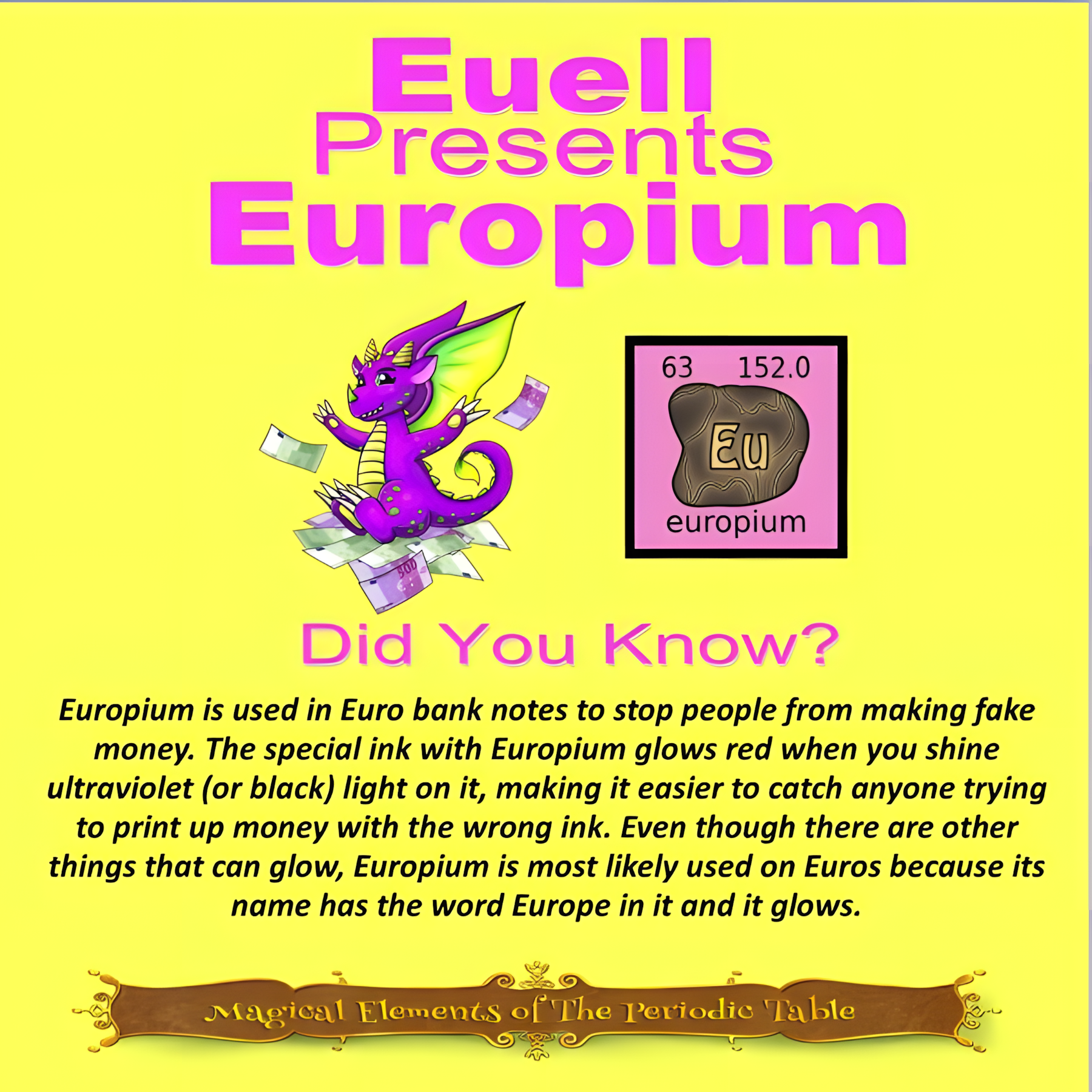
This article is brought to you by Sybrina Durant, the author of the middle grade picture book, Magical Elements of the Periodic Table Presented Alphabetically By The Elemental Dragons. Learn More. In that book Europium is presented by the dragon, Euell.


Inter-Active Elemental Fantasy-Themed Periodic Table from Magical Elements of the Periodic Table Presented Alphabetically by The Elemental Dragon Clan
Click here to use This Inter-Active Viewer To Learn More About The Elements Each Elemental Represents On This Periodic Table. Want this in a 24″ x 36″ Poster? Click here.

Sybrina Publishing Offers Fun Activities Based On The Book
Magical Elements of the Periodic Table Magical Elementals
Browse Magical Elemental Activities at MagicalPTElements or Sybrina-Publishing on TPT or Classful