
Discovering Tellurium: A Journey Through Science

Hey there, science enthusiasts! Today, we’re diving into the fascinating world of elements and focusing on a rather unique one: Tellurium. You might not have heard of it before, but this element has some cool properties and a pretty interesting history. So, let’s get into how we discovered Tellurium and where it fits into the periodic table!
Tellurium is represented by the symbol “Te” on the periodic table and has the atomic number 52. This means that a single atom of Tellurium has 52 protons in its nucleus. It belongs to the group of elements known as the chalcogens, which also includes oxygen, sulfur, selenium, and polonium. Tellurium is a metalloid, which means it has properties of both metals and non-metals. It is silvery-white in color and has a brittle texture, making it look quite different from the shiny metals you might be used to seeing.
The story of Tellurium begins in 1782, when a Hungarian chemist named Franz Joseph Müller von Reichenstein discovered a new mineral in Transylvania. He originally thought it contained a new element, and he named it “Tellurium” after the Latin word for Earth, “Tellus.” However, it wasn’t until 1798 that the element was isolated and identified as distinct from others by Martin Heinrich Klaproth, a German chemist. Klaproth is also known for discovering other elements like uranium and zirconium.
Tellurium isn’t found in its pure form in nature; instead, it occurs in certain minerals, often associated with metals like copper and gold. The extraction of Tellurium usually takes place in a couple of steps:
1. Mining: First, miners dig up ores that contain Tellurium. Common ores include telluride minerals such as calaverite, which is a gold telluride.
2. Roasting and Smelting: Once the ore is extracted, it undergoes a roasting process where it’s heated in the presence of oxygen. This helps convert the minerals into more usable forms. After roasting, the ore is smelted, which means it’s heated to a high temperature in order to separate the metals from the slag—a waste material that’s left after extraction.
3. Purification: The final step is to purify the Tellurium. This can involve further chemical processes where impurities are removed, leaving behind the pure element.
Now that we know how it’s made, you might be wondering why Tellurium is important. It has several fascinating applications! One of its primary uses is in the production of alloys, particularly in steel-making, where it helps improve strength and resistance to corrosion. Additionally, Tellurium is widely used in the semiconductor industry, playing a crucial role in various electronics like solar panels and memory devices.
Understanding elements like Tellurium not only helps us appreciate the building blocks of matter but also opens doors to innovations in technology and materials that affect our daily lives. The periodic table is like a treasure map of science, and each element has its own story and significance.
In conclusion, Tellurium is more than just an obscure element on the periodic table. From its discovery to its industrial applications, it’s a prime example of how much there is to explore in the world of chemistry. So, the next time you look at the periodic table, remember the journey of Tellurium and all the wonders that come with it! Happy exploring!
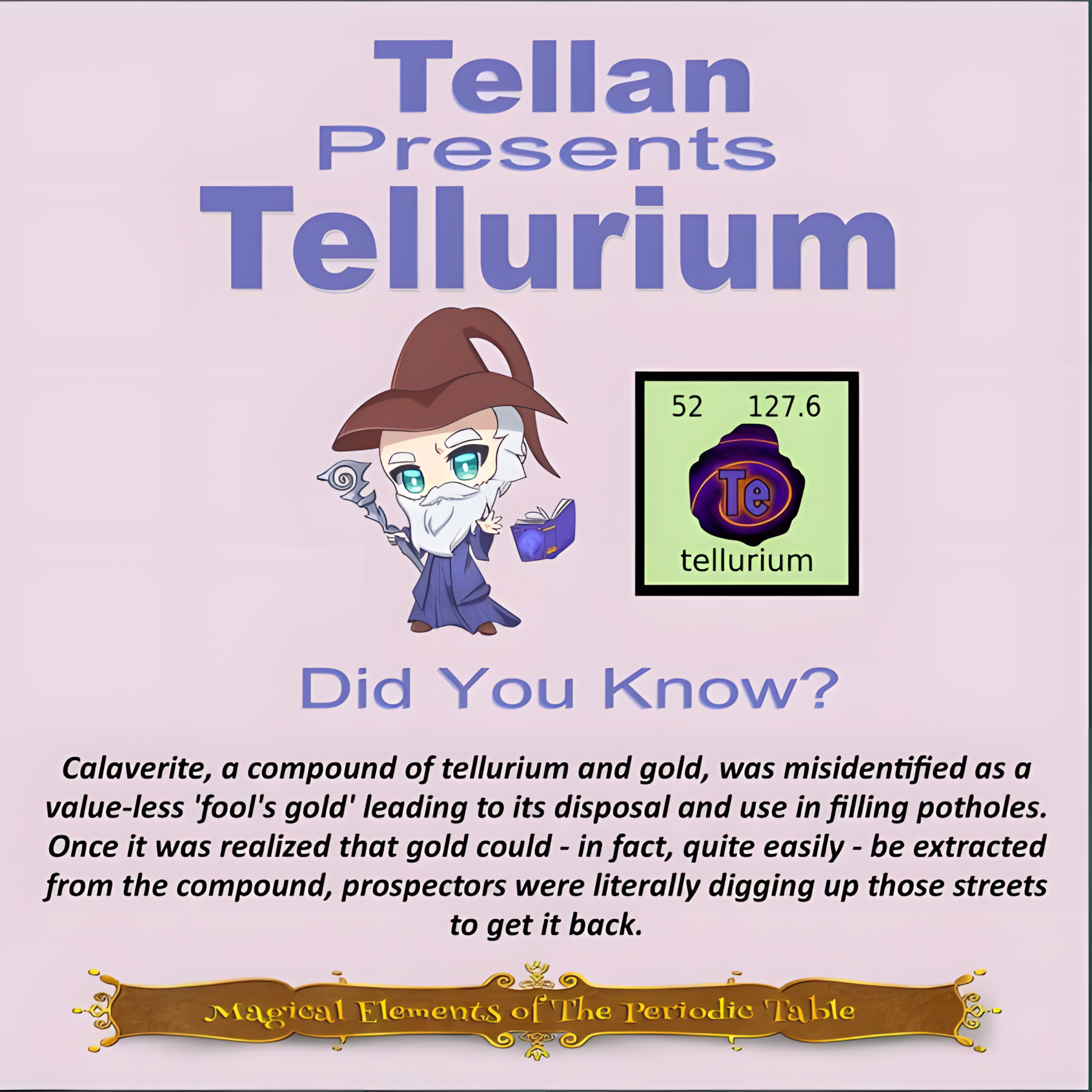
This article is brought to you by Sybrina Durant, the author of the middle grade picture book, Magical Elements of the Periodic Table Presented Alphabetically By The Elemental Wizards. Learn More. In that book Tellurium is presented by the Wizard, Tellan.

Inter-Active Elemental Fantasy-Themed Periodic Table from Magical Elements of the Periodic Table Presented Alphabetically by The Elemental Dragon Clan
Click here to use This Inter-Active Viewer To Learn More About The Elements Each Elemental Represents On This Periodic Table. Want this in a 24″ x 36″ Poster? Click here.

Sybrina Publishing Offers Fun Activities Based On The Book
Magical Elements of the Periodic Table Magical Elementals
Browse Magical Elemental Activities at MagicalPTElements or Sybrina-Publishing on TPT or Classful