

An intriguing element is Flerovium, a chemical wonder that captures the imagination with its tantalizing possibilities and enigmatic qualities. Although this element, symbolized as Fl and with the atomic number 114, is an extremely rare gem in the periodic table, its story is anything but ordinary.
Flerovium was first synthesized in 1998 by a group of Russian scientists at the Joint Institute for Nuclear Research in Dubna. Their discovery was named after the Flerov Laboratory of Nuclear Reactions, which itself was named after Georgy Flerov, a Russian physicist credited with pivotal advancements in the study of nuclear reactions. They created Flerovium by smashing together ions of calcium-48 with atoms of plutonium-244—a process that sounds more like a high-stakes game of billiards than a scientific experiment. What emerged from this nail-biting collision were just a few atoms of this brand-new element, each lasting only a fleeting heartbeat before vanishing, as if they had never existed at all.

Flerovium belongs to a group of elements known as the post-transition metals and is found in the same family as tin and lead on the periodic table. This means it shares certain characteristics with them, but being a superheavy element, Flerovium is rather unique. Its atomic structure is full of quarks and electrons swirling around, creating a dance of complexity that scientists are only beginning to unravel. Its very existence challenges our understanding of the limits of chemical bonds and the nature of matter itself.
Now, you might wonder, “What can we actually do with Flerovium?” The truth is, we currently don’t use Flerovium commercially. The main reason is that it is incredibly unstable; its atoms decay almost instantaneously, existing for mere milliseconds before breaking down into lighter elements. Because of this fleeting life, practical applications remain a dream. However, scientists are hopeful that by studying Flerovium and other superheavy elements, they can unlock new materials and technologies that could change our world in mind-bending ways.

Speculatively, some scientists believe that elements like Flerovium could potentially have extraordinary properties. Imagine materials that are lighter than air but stronger than steel, or elements that can conduct electricity with zero resistance. If we could learn to harness the secrets of Flerovium’s atomic structure, we might find ourselves with breakthroughs in energy storage, quantum computing, or even new methods for medical imaging.
Think about it, every great invention in our history—like the telephone or the internet—began with a spark of imagination. Scientists often form theories based on their understanding of how elements interact and respond to different conditions. This leads to a speculative sense of excitement regarding Flerovium. What if we could stabilize it? What if we found out that it can be used for creating materials designed specifically for space travel? The very thought sends a shiver of anticipation and wonder as we think of a future where Flerovium serves a critical role in pushing human exploration beyond our planet!
In addition to the possibilities it suggests, every scientific discovery often has a story or two that casts a light upon the human spirit. The journey to discover Flerovium wasn’t without its hurdles. The Russian scientists were working in the midst of many other high-energy physics experiments, contributing to a fiercely competitive global race in the realm of atomic research. The success of synthesizing an element that was previously only imagined was, in itself, a victory reflecting the tenacity of human ingenuity. Within those cold, sterile laboratory walls lay the hopes of scientific storytellers who longed to carve a new chapter in the narrative of chemistry.
And although Flerovium has a limited practical application today, its discovery signifies so much more. It is a testament to human curiosity, a reminder of the wonders lying just beyond our current comprehension. Scientists continue to explore the potential of both Flerovium and its elemental siblings, chasing the whispers of what once seemed improbable.
In the imagination of tomorrow, Flerovium serves not only as an elusive element on the periodic table but also as a symbol of the unknown—inviting dreamers, innovators, and even storytellers to ponder its possibilities. The world of Flerovium and what it may hold is a reminder that the story of elements is still being written, and the pages are far from finished.
This article is brought to you by Sybrina Durant, the author of the Magical Elements of the Periodic Table Book Series. Learn More.

Inter-Active Elemental Fantasy-Themed Periodic Table from Magical Elements of the Periodic Table Presented Alphabetically by The Elemental Dragon Clan
Click here to use The Inter-Active Viewer for the periodic table above to learn more about the elements each elemental represents on this periodic table. Want this No Metal No Magic periodic table in a 24″ x 36″ Poster? Click here.

Sybrina Publishing Offers Fun Activities Based On The Book
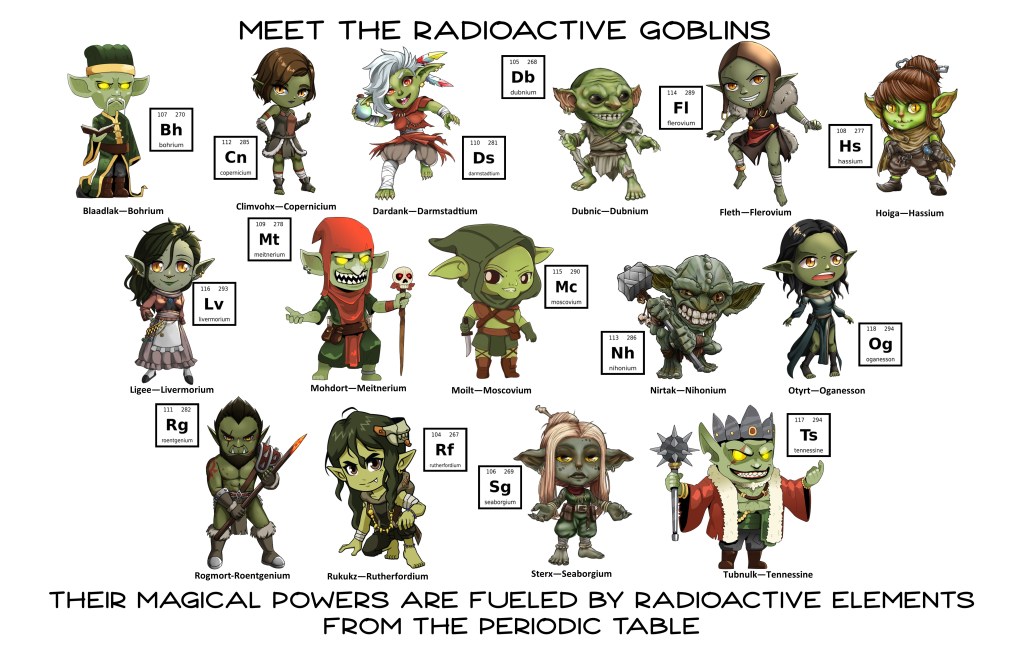
Magical Elements of the Periodic Table Magical Presented By The Radioactive Goblins
Browse Magical Elemental Activities at MagicalPTElements or Sybrina-Publishing on TPT or Classful
