
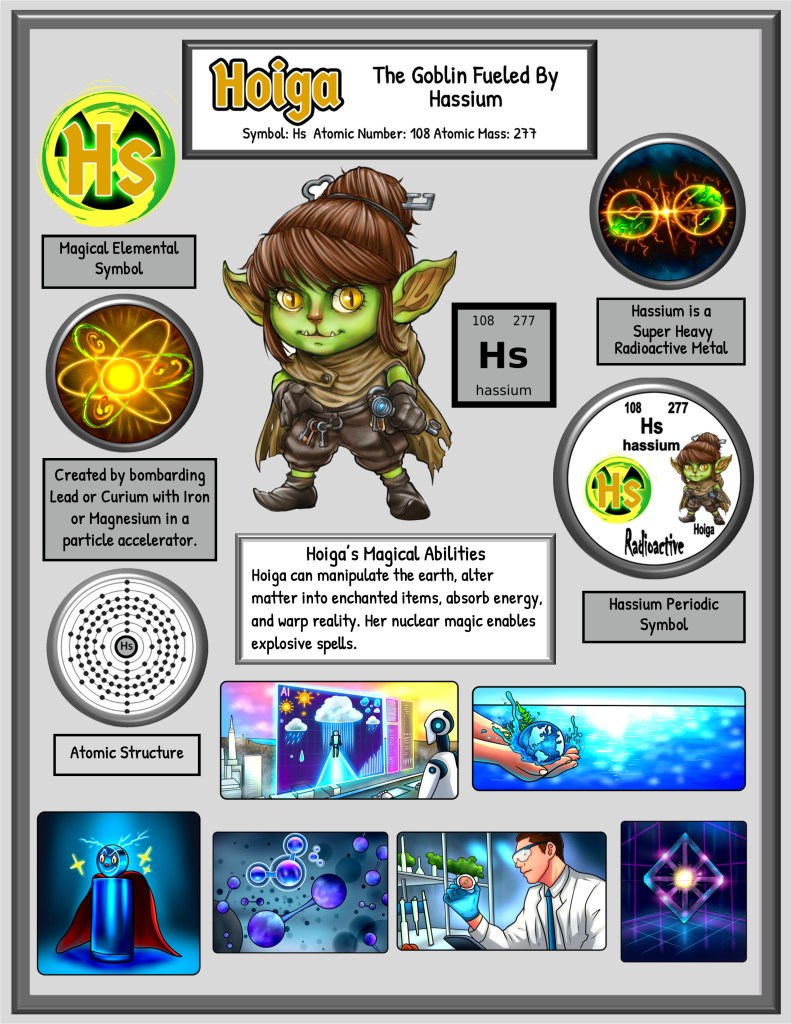
Hassium is a rare and elusive gem of the periodic table. With an atomic number of 108, this element is a member of the transition metals, nestled snugly in Group 8, beneath its more famous cousins like Iron (Fe) and Platinum (Pt). Picture this: nestled between the familiar and the unknown lies Hassium, a fleeting wisp of science that sparks both wonder and curiosity.
Let us journey back to the late 20th century, specifically the year 1984, when scientists at the Institute for Heavy Ion Research in Darmstadt, Germany, first synthesized Hassium. They accomplished this feat by bombarding lead (Pb) with ions of a heavier element, the ununseptium (now known as Tennessine). This teams of physicists weren’t just chasing dreams; they were pioneers in the search for new elements, dedicated to expanding our understanding of atomic structure.
Imagine a scene in a lab filled with beeping machines and the excited chatter of researchers. They’re surrounded by complex equipment, spinning particles, and the glossy sheen of lead. After the painstaking process of manipulating atomic structures, the moment finally arrives—a new element is born! But there’s a catch. Hassium is incredibly unstable, with a half-life measured in milliseconds, making it as fleeting as a whisper on the wind. Scientists managed to create only a handful of atoms, which disappeared almost as quickly as they were made, leaving a tantalizing question lingering in the air: What can this enigmatic element potentially offer to the world?
At present, Hassium is not used commercially—not because it lacks potential, but primarily due to its rarity and instability. With its vanishing act so swift, there simply isn’t enough Hassium available for practical applications. It sits littered across the scientific landscape, a treasure that no one can quite lay their hands on. The price tag for producing Hassium is astronomical, with estimates suggesting hundreds of millions of dollars for just a few atoms. The vast majority of scientists agree that significant commercial applications are merely a distant dream.
What about tomorrow? What might Hassium hold for us in the realms of science and imagination? Positioned on the periodic table near the noble metals, it shares some properties with its neighbors that could shape new technologies in the years to come. Some scientists believe that, because of its unique properties—such as potentially high density or interesting magnetic behavior—Hassium could play a role in advanced materials science and nuclear applications.
Think of the possibilities: materials that are lighter yet stronger, capable of transforming technology in ways we can barely fathom. In a science fiction vision, one might imagine Hassium being used to develop next-generation supercomputers, or perhaps energy sources that harness the power of atomic phenomena. A dense, stable isotope might be the key to unlocking efficient fusion energy, a clean source that could meet humanity’s growing power demands.
Science fiction writers thrive on the allure of elements like Hassium. They project its potential into fantastical realms where scientists harness its power for interstellar travel or to create exotic engines that defy the laws of physics as we know them. Imagine, if you will, a spaceship powered by a Hassium fuel core, its propulsion system propelling it across galaxies. As the ship glides through the stars, the crew experiences time distortion and travels vast distances in the blink of an eye, all thanks to the mysterious properties of this enigmatic element.
The world of Hassium is not without its stories. Although the element is a scientific feat, its discovery has merged with myth-like fascination. Scientists often nickname elements during their discovery, and Hassium was named after Germany (Hassia being the Latin term) to honor the nation hosting the lab that manifested it. This lyrical background gives Hassium a cultural significance beyond mere atomic structure.
Moreover, the very act of creating Hassium serves as a testament to humanity’s relentless pursuit of knowledge—a reminder that we are explorers in a universe filled with mysteries. The tireless researchers who worked to create and study it have contributed to the understanding of atomic structure, inspiring generations to come.
As we contemplate the position of Hassium on the periodic table, its ephemeral existence, and the peppering of imagination that comes from its potential uses, we are reminded of the wonders that lie hidden in the veins of the universe. From a fleeting atom to the bubbling aspirations of future scientists, Hassium embodies the spirit of discovery—a beacon of hope, imagination, and scientific possibility. Who knows what tomorrow may hold? Perhaps one day, Hassium will be more than just an element in a list; it will be a cornerstone of innovation that changes our world forever. Until then, it remains a beautiful enigma, reverberating quietly in the hallways of science, whispering tales of what could be.
This article is brought to you by Sybrina Durant, the author of the Magical Elements of the Periodic Table Book Series. Learn More.

Inter-Active Elemental Fantasy-Themed Periodic Table from Magical Elements of the Periodic Table Presented Alphabetically by The Elemental Dragon Clan
Click here to use The Inter-Active Viewer for the periodic table above to learn more about the elements each elemental represents on this periodic table. Want this No Metal No Magic periodic table in a 24″ x 36″ Poster? Click here.

Sybrina Publishing Offers Fun Activities Based On The Book
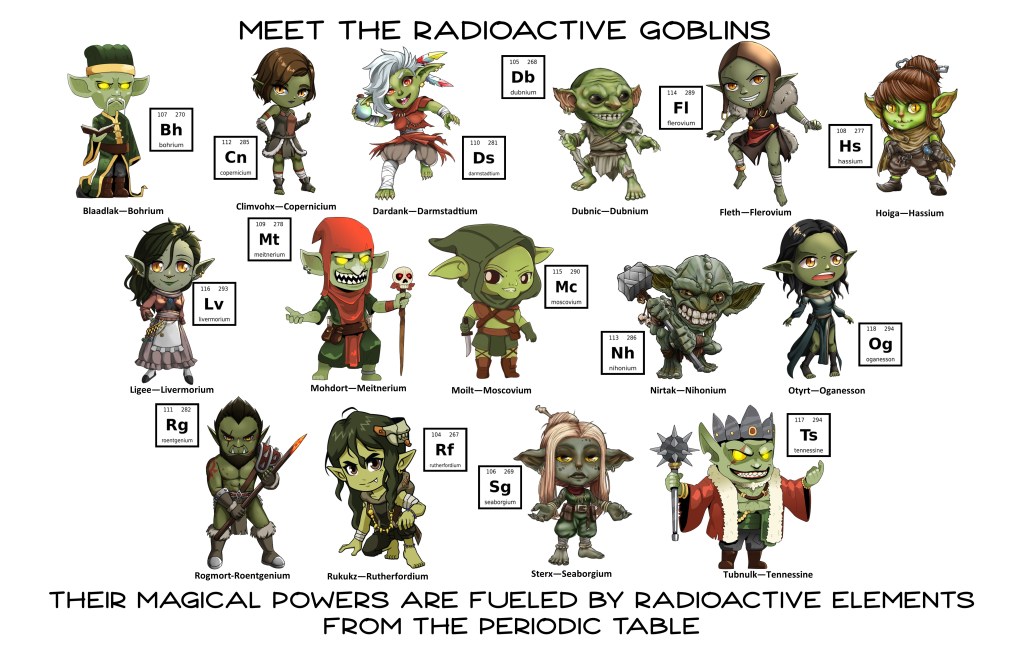
Magical Elements of the Periodic Table Magical Presented By The Radioactive Goblins
Browse Magical Elemental Activities at MagicalPTElements or Sybrina-Publishing on TPT or Classful