

In the vast cosmic dance of elements that make up our universe, one stands out not just for its uniqueness but also for its intriguing backstory: Livermorium, a synthetic element with the atomic number 116. Named after the Lawrence Livermore National Laboratory in California, where it was discovered, Livermorium (symbol Lv) is a fleeting ghost of an element, deeper and denser than most of us can comprehend.
Livermorium belongs to the group known as the **post-transition metals** and sits in the lower part of the periodic table, nestled among its fellow “superheavy” elements. Its neighbors include elements like Moscovium and Nihonium, which are also synthetic and exist only for brief moments before decaying into lighter elements. For most people, their names may sound like something out of a science fiction novel, but they are very much a part of our scientific reality.

Commercially speaking, Livermorium isn’t doing much. In fact, that’s an understatement. It has no known commercial uses, primarily because it is barely comprehensible in terms of practical applications. This element is so unstable that it can only be produced in tiny amounts—just a couple of atoms at a time—lasting less than a thousandth of a second before decaying. But perhaps therein lies its allure, a question of what might be if we could do more than just glimpse this enigma.
So why are scientists so fascinated by Livermorium if it doesn’t have any current applications? Here’s where things get imaginative. Being a member of the group of superheavy elements, Livermorium sits at the intersection of theoretical physics and chemistry, sparking wonder about the nature of elements themselves. Some scientists speculate that exploring Livermorium could help uncover new principles of periodicity, which governs how elements behave.
Looking into the future, the possibilities for synthetic elements like Livermorium are tantalizing. One compelling speculation revolves around the idea that these superheavy elements could help us unlock the secrets of energy and materials science. They might lead to breakthroughs in superconductors—materials that can conduct electricity without resistance, which might transform our technology and energy sectors.

In science fiction, these imagined functionalities are often realized in the form of miraculous materials that could revolutionize everything from power generation to spaceship construction. While we’re perhaps a bit far from wrapping our heads around the wormholes and faster-than-light travel (as often depicted in movies), the study of elements like Livermorium pushes the boundaries of what’s scientifically possible.
The discovery of Livermorium itself is a story of ingenuity and collaboration. In 2000, scientists from the **Joint Institute for Nuclear Research** in Dubna, Russia, and the Lawrence Livermore National Laboratory in the USA collaborated to create this elusive element. They fired calcium ions at a target composed of curium isotopes, orchestrating a symphony of subatomic particles to generate Livermorium. This monumental task didn’t just involve science; it required a vision of what might be achievable through collaboration across borders.
The celebration that followed its discovery was not just of scientific achievement; it was a testament to human curiosity and the drive to expand our understanding of the universe. Each new element discovered acts as a new chapter in the ongoing narrative of our quest for knowledge, revealing how little we truly know about the building blocks of matter.
Livermorium remains shrouded in a glowing mist of potential. While it’s not lighting commercial fires today, who can say what it could unveil for future generations? The very act of creating this element opens doors to deeper questions about atomic structure and stability. Just as the discovery of other elements led to revolutionary changes in technology, understanding Livermorium could inspire future chemists and physicists to unlock secrets of the universe that we haven’t even dreamed of yet.
Who knows? Perhaps one day, Young students, like you, will read about Livermorium in their science textbooks as a stepping stone towards an era brimming with possibilities. Researchers and inventors might look back at Livermorium’s unstable glory and think, “That’s where it all began.”
Elements like Livermorium may be mere footnotes in the grand saga of existence for now, but within them lie the whispers of the unknown, igniting the flames of curiosity that drive humanity forward. And in that spark, you might find you’re more connected to the electrifying dance of atoms than you ever imagined!
This article is brought to you by Sybrina Durant, the author of the Magical Elements of the Periodic Table Book Series. Learn More.

Inter-Active Elemental Fantasy-Themed Periodic Table from Magical Elements of the Periodic Table Presented Alphabetically by The Elemental Dragon Clan
Click here to use The Inter-Active Viewer for the periodic table above to learn more about the elements each elemental represents on this periodic table. Want this No Metal No Magic periodic table in a 24″ x 36″ Poster? Click here.

Sybrina Publishing Offers Fun Activities Based On The Book
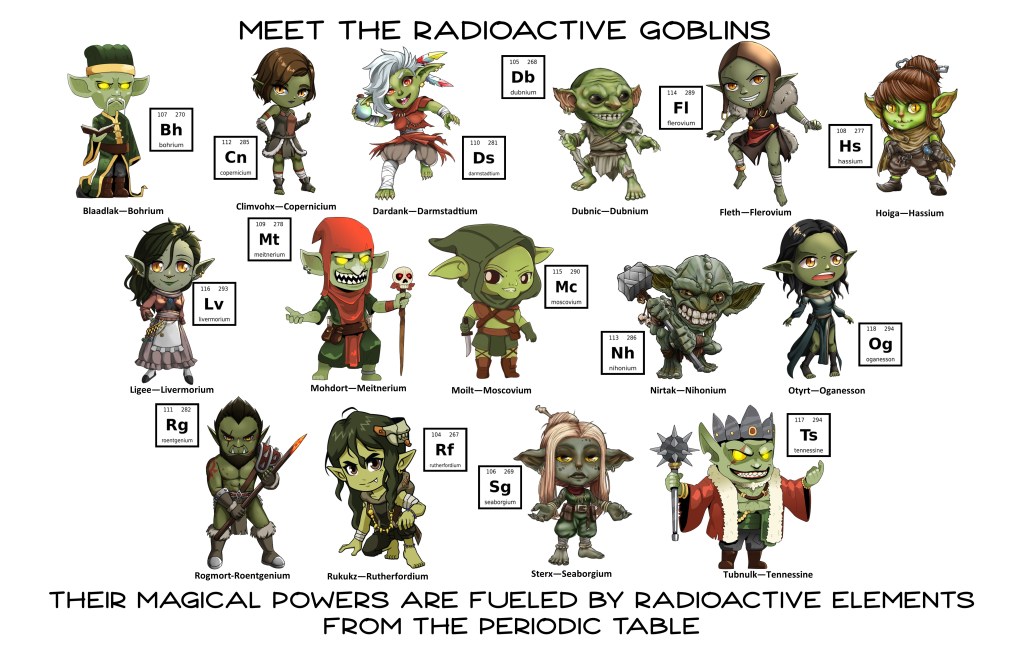
Magical Elements of the Periodic Table Magical Presented By The Radioactive Goblins
Browse Magical Elemental Activities at MagicalPTElements or Sybrina-Publishing on TPT or Classful
