How Do We Get It? – Nitrogen

How Do We Get It? – Nitrogen. The Origin of Nitrogen: A Key Element in Nature. Nitrogen, symbolized by the letter N on the periodic table, is an essential element for life on Earth. It is the fourth most abundant element in the universe and plays a crucial role in both organic and inorganic processes. But where does nitrogen come from, and how is it obtained for commercial use? In this article, we will explore the origin of nitrogen, its presence in nature, the extraction and mining processes, commercial processing, and the countries that dominate its production and their impact on the environment.

Continue reading

First Uses of the Periodic Table Element -Deuterium

First Uses of the Periodic Table Element -Deuterium. The Early Days of Deuterium: Pioneering Uses and its Evolving Role. When it comes to hydrogen isotopes, most of us are familiar with protium, the lightest and most common form. However, there is another isotope, deuterium, that has played a significant role in scientific research and practical applications since its discovery in 1931. Its initial applications were groundbreaking, yet over time, deuterium was gradually replaced by more efficient alternatives. Let us delve into its early uses and explore the reasons behind its decline from those specific purposes.

Continue reading

First Uses of the Periodic Table Element – Quicklime

First Uses of the Periodic Table Element – Quicklime.The Historical Significance of Quicklime: Exploring its Early Uses and Why it Fell Out of Favor.Quicklime, also known as calcium oxide (CaO), holds a prominent position in the annals of human history. From ancient civilizations to medieval times, this versatile compound played a crucial role in various applications. However, as time progressed and newer alternatives emerged, the use of quicklime for its original purposes declined. In this article, we delve into the early uses of quicklime and the reasons behind its reduced popularity in contemporary times.

Continue reading

First Uses of the Periodic Table Element – Francium

First Uses of the Periodic Table Element – Francium. The Forgotten Element: Francium’s Historic Uses and Abandonment. In the vast periodic table of elements, francium (Fr) holds a position shrouded in mystery and intrigue. As the second rarest naturally occurring element on Earth, francium’s enigmatic nature has captivated scientists since its discovery in 1939. Initially believed to have revolutionary applications across multiple fields, francium’s potential was soon overshadowed by its inherent instability and radioactivity. In this article, we delve into the first uses of francium and explore why it is no longer employed for those purposes.

Continue reading

First Uses of the Periodic Table Element -Tin

First Uses of the Periodic Table Element -Tin. The Evolution of Tin: From Ancient Uses to Modern Alternatives. Tin, a versatile metal with a long history of human use, has served myriad purposes throughout the ages. From ancient civilizations to the modern world, this resilient and malleable material has been utilized in various applications. However, as time progressed and new discoveries were made, alternative materials were found to be more suitable for certain purposes. In this article, we explore the first uses of tin and the reasons why it is no longer extensively used for those purposes.

Continue reading

First Uses of the Periodic Table Element -Neodymium

First Uses of the Periodic Table Element – Neodymium. Neodymium, a fascinating and powerful element on the periodic table, has made waves in the world of science and technology since its discovery in the late 19th century. For a 14-year-old reader, understanding the first uses of neodymium can shed light on how this element has revolutionized various industries.

Continue reading

How Do We Get It? – Ytterbium

How Do We Get It? – Ytterbium. Ytterbium: Exploring the Origins and Extraction of a Valuable Element. Ytterbium, symbolized as Yb in the periodic table, is a rare earth element with atomic number 70. It was discovered in the early 19th century by a Swedish chemist, Carl Gustaf Mosander. Ytterbium is rich in applications, particularly in the field of science and technology. In this article, we will delve into the origin of ytterbium, its occurrence in nature, extraction processes, commercial processing, mining economies, and the environmental implications associated with its production.

Continue reading

How Do We Get It? – Nickel

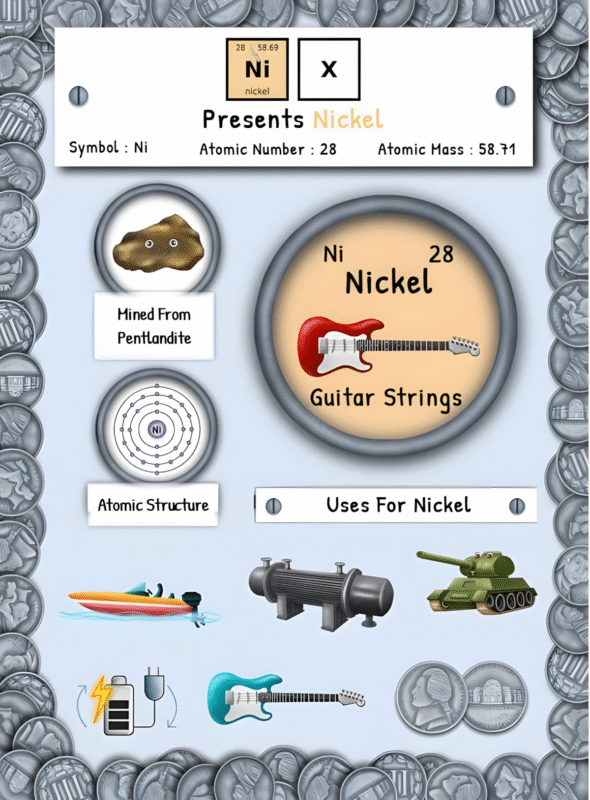
How Do We Get It? – Nickel. The Origin and Production of Nickel: A Versatile Metal. Nickel, a versatile and important metal, is widely used in various industries due to its unique properties. From electronics to aerospace, this element plays a crucial role in various applications. But have you ever wondered where nickel comes from and how it is processed? In this article, we will explore the origin of nickel, its extraction process, commercial processing, and the leading nations in nickel mining and production.

Continue reading

How Do We Get It? – Iron

How Do We Get It? – Iron. The Origin of Iron: From Natural Occurrence to Commercial Production.Iron is an essential element for modern society, playing a pivotal role in the development of civilization and technological advancements. From its natural occurrence to its commercial production, the story of iron is fascinating and interconnected with the environment and human activity. In this article, we will explore the origin of iron, its extraction from various sources, the mining process, commercial processing methods, the leading iron-mining countries, and their environmental impacts.

Continue reading