
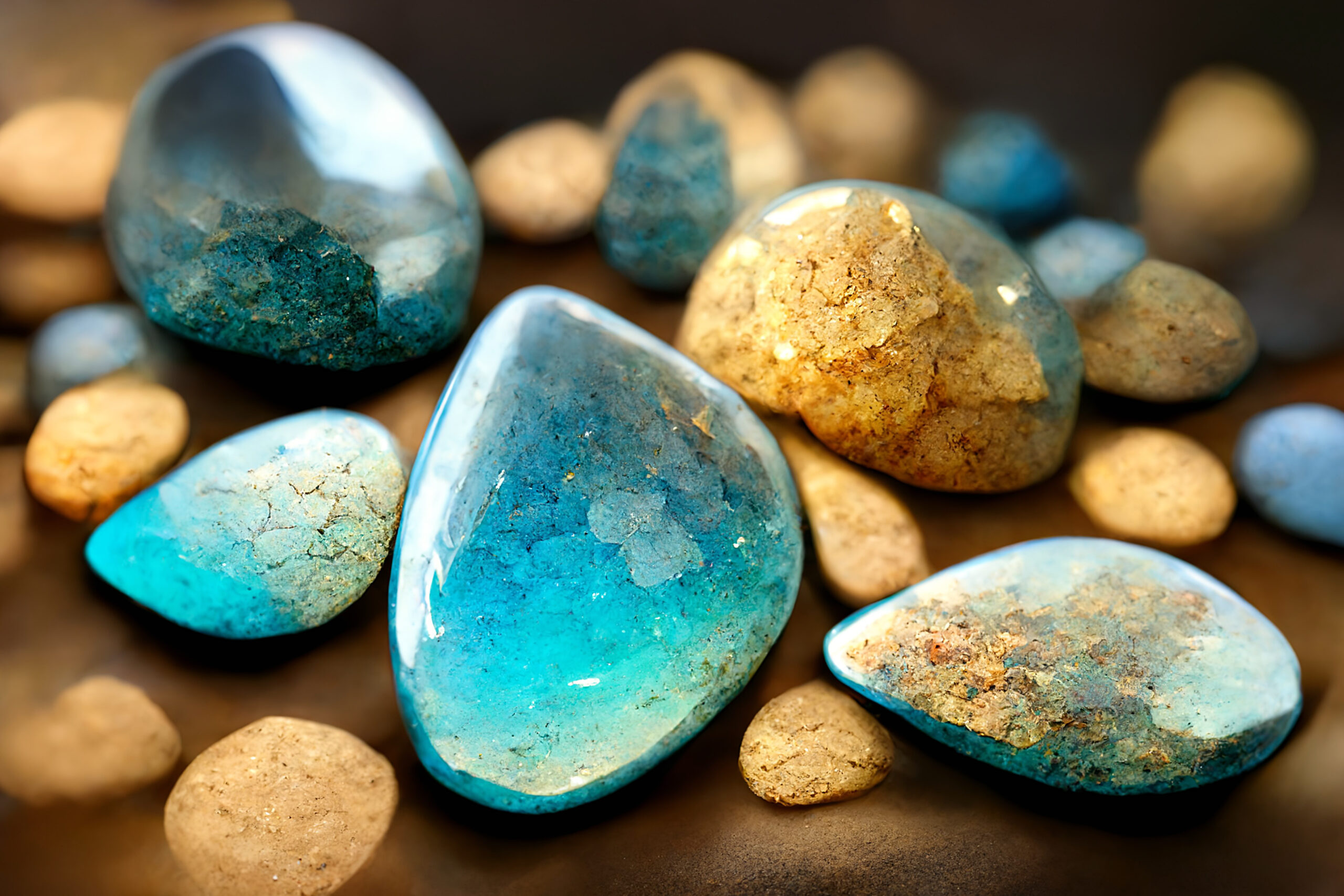

Turquoise is an attractive gemstone that captures the imagination with its stunning blue and green colors. This mineral has a long history, radiating a sense of mystery and beauty that dates back thousands of years. Notably recognized as December’s primary birthstone, turquoise symbolizes protection and good fortune, making it an excellent choice for those born in this month.
At its core, turquoise is composed of a complex chemical structure, defined by the formula CuAl₆(PO₄)₄(OH)₈·4H₂O. This reveals that turquoise is a hydrated mineral made up of copper, aluminum, phosphorus, oxygen, and hydrogen, which work together to create its unique properties. Understanding these elements helps us appreciate not only the beauty of turquoise but also the science behind it.
One of the most essential components of turquoise is copper (Cu). This element plays a starring role and is responsible for the vibrant blue hues that turquoise is famous for. The concentration of copper within the mineral determines the depth of its color, with higher amounts leading to more intense shades of blue. Just beneath copper in importance is aluminum (Al), which fits into the crystal arrangement of turquoise and primarily comes from the surrounding rock formations, often including minerals like feldspar and clay. Alongside copper and aluminum is phosphorus (P), sourced from phosphate ions that form a crucial part of turquoise’s very structure.
Adding to this complex structure are oxygen (O) and hydrogen (H), which make their appearance in hydroxyl groups and water molecules. Interestingly, turquoise contains between four to ten percent water, which contributes to its ability to absorb and retain moisture, a quality that affects its durability and appearance. The chemistry of turquoise is also enriched by trace elements that can alter its color, such as iron (Fe), which replaces aluminum within the crystal lattice, adding green or yellowish tones to the stone. Other trace elements like zinc and calcium can also influence the hue, leading to variants, sometimes referred to as “matrix turquoise,” which contains patterns of the host rock it formed with.

Zinc can introduce a yellowish or greenish tone and can also give it a brownish tint. When turquoise contains high levels of zinc, it may take on a beautiful yellow-green color, which can be seen in some turquoise found in locations like the Blue Ridge mine. This mine has gained recognition for its striking yellow-green turquoise, showcasing the influence of zinc on the stone’s appearance.
Calcium is another important element in turquoise, though it does not directly add color. Instead, calcium appears in the form of calcium carbonate, and while it doesn’t affect color directly, it helps create the milky-white appearance notable in some varieties of turquoise. The microscopic calcium carbonate particles scattered throughout the stone reflect and scatter sunlight, which affects how we perceive its coloration. When light hits these tiny particles, it causes turquoise to predominantly reflect blue and green wavelengths, enhancing its bright and captivating colors.
Turquoise forms in nature through a fascinating process that occurs in arid environments rich in copper. Through a process called weathering, acidic groundwater seeps through rock and dissolves copper and aluminum needed to create turquoise. When these elements combine in fractures of volcanic or sedimentary rocks, they precipitate, forming the beautiful turquoise we see. This process often takes place in areas filled with kaolinite, iron oxides, and quartz, further contributing to the unique matrix patterns that characterize many turquoise stones.
Historically, turquoise has held a prominent place in various cultures around the world. This gemstone has been mined for over 5,000 years, with the ancient Egyptians and Persians regarding it as a powerful protective talisman. Native Americans and Aztecs also celebrated turquoise for its spiritual significance, believing it brought harmony and comfort to its wearer. In particular, Persian turquoise is highly prized for its pure blue color and has been sought after since ancient times. In contrast, Southwestern U.S. turquoise typically presents a greenish tint due to higher iron content.
As December’s birthstone, turquoise is not only revered for its beauty but also for its protective qualities. Many cultures have celebrated turquoise as a stone of good fortune, believed to guard against negative energies and provide strength to its wearer. Additionally, turquoise is thought to bring peace and tranquility, making it an ideal gemstone for those born in the final month of the year, a time often associated with reflection and gratitude.

The popularity of turquoise extends beyond its natural beauty. It has been a frequent choice for jewelry and decorative arts owing to its captivating color and perceived virtues. However, the porosity of turquoise also poses challenges, as it can be susceptible to discoloration from oils, cosmetics, or even sunlight. To protect the stone and enhance its beauty, many turquoise pieces undergo stabilization treatments involving epoxy or wax that improve their durability.
While discovering the wonders of turquoise, it is essential to know how to differentiate it from similar minerals, like variscite or chrysocolla, which may mimic its color but lack the characteristic copper inclusions. Turquoise can also be mistaken for howlite, particularly when dyed to imitate the iconic shades of blue.
As intriguing as the stone can be, the cultural history surrounding turquoise adds another layer of depth. It has thrived in various traditions across the globe, featuring differently in ancient Hebrew or Roman calendars as well as more contemporary systems. With an evolving perspective on birthstones, new materials like zircon or blue topaz sometimes find their way onto lists. Yet, turquoise remains a lasting symbol of December, echoing through time as a stone of protection, harmony, and timeless beauty.
This article is brought to you by Sybrina Durant – author of the Magical Elements of the Periodic Table series of books. Get them all plus activities, games and elemental tees here.