
Cobalt

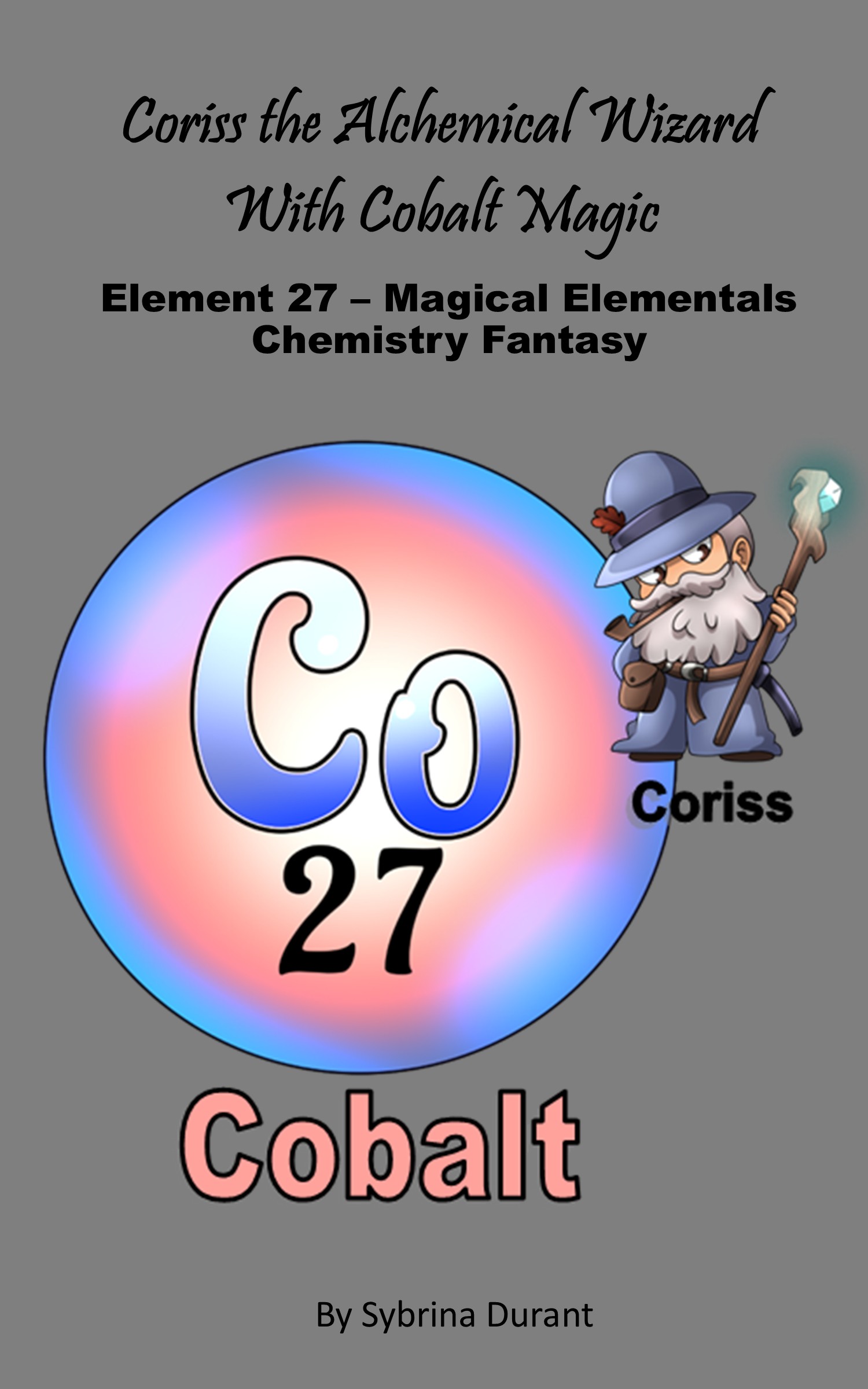
This is the front side of the game card for Coriss The Wizard With The Cobalt Tipped Staff. Click the pic to take a look at all the fun info on the back. Use it as a memorization tool, a trading card or as science class prizes and rewards.

Coriss’ Story Coming Soon

2 – https://www.rsc.org/periodic-table/element/27/cobalt
3 – https://www.lenntech.com/periodic/elements/co.htm
5 – https://periodictable.com/Elements/027/data.html
9 – https://en.wikipedia.org/wiki/Cobalt
10 – https://chemistrydictionary.org/cobalt/
11 – https://www.livescience.com/29275-cobalt.html
12 – https://www.mining-technology.com/features/australia-cashes-in-on-cobalt/
13 – https://www.cobaltinstitute.org/about-cobalt/cobalt-life-cycle/cobalt-mining/


Links and Notes for Coriss’ chemistry inspired magical abilities:
Cobalt chloride’s pink-to-blue color shift (the crucible scene in Chapter One, and real-world analog for “old magic”)
- The equilibrium between two coloured cobalt species – RSC Education
- E720: Effect of temperature on [Co(H2O)6]²⁺/[CoCl4]²⁻ – CU Boulder Lecture Demo Manual
- Cobalt(II) Chloride Equilibrium – HSC Chemistry
- COBALT CHLORIDE – Molecule of the Month, University of Bristol
Cobalt as an element — magnetism, why it’s the natural choice for a “resonance” magic (the staff’s magnetic pulses and Coriss’s affinity)
- Cobalt | Uses, Properties, & Facts – Britannica
- Hard and semi-hard magnetic materials based on cobalt and cobalt alloys – ScienceDirect
Cobalt blue pigment / cobalt glass (historical texture for “old magic,” since cobalt really has been used for centuries to make vivid, stable blue)
- Cobalt blue – Wikipedia
- Cobalt glass – Wikipedia
- Pigments through the Ages: Cobalt blue – WebExhibits
Chromium corrosion/surface chemistry (the real-world basis for Valon’s “chromium magic” — surface transformation, corrosion, reflectivity)
- Chromate conversion coating – Wikipedia
- Passivation (chemistry) – Wikipedia
- Chromium Plating – ScienceDirect Topics
- Why Is Chromium Coating Corrosion Resistant? The Power of a Self-Healing Oxide Shield
Iron corrosion / rust (backs up the “iron work crumbling like chalk” and the Chromethysts’ corroded appearance)
Zinc sulfide glow-in-the-dark chemistry (grounds the luminescent zinc-painted path stakes in the Thornmere)
- Zinc sulfide – Wikipedia
- Phosphorescence – Wikipedia
- Experiments with Glow-in-the-Dark Toys: Kinetics of Doped ZnS Phosphorescence – Journal of Chemical Education
- The specific magical effects themselves — igniting stone or enchanted metal with a touch, “truth-light” that makes lying physically uncomfortable, dissolving illusions, or temporarily transferring heat immunity to another person — are fictional extensions of real chemical properties, not real phenomena.
- The Ember Familiar (a fire sprite) and Sylphrenna (a lightning-charged storm-fox spirit) are entirely fictional magical creatures.
- Ley-gate teleportation, Isolde’s river-warded fast travel, and Fenwick’s fully autonomous steam-powered mechanical raptor are fictional technologies and magic systems.
- The world of MarBryn itself, its single moon and the “Moon-Star,” the city and location names (Hollowmere Vale, Emberhold Spire, Kaelport, the Sunken Foundry, Glassmere Lake, the Obsidian Wastes, Ashenmoor Citadel), and the “no metal, no magic” philosophy are all invented worldbuilding.
- The villain’s “Cascade Array” — a device that stores and weaponizes harvested oxidative energy to age metal across an entire region in an instant — has no real-world counterpart and is a dramatized, fictional escalation of real oxidation chemistry.