
In the vast universe of science, there lies a hidden wonder tucked away in the 109th position of the periodic table: Meitnerium. Named in honor of the brilliant physicist Lise Meitner, this element stands as a testament to the persistence of scientific inquiry and the quest for understanding the very building blocks of our universe.
Meitnerium, with the chemical symbol Mt, is a synthetic element, which means it does not occur naturally on Earth and has to be made in a lab by smashing lighter atoms together in a particle accelerator. Discovered in 1982 at the GSI Helmholtz Centre for Heavy Ion Research in Germany, it took scientists several years to confirm its existence, a process that echoes the patience and tenacity that characterize great discoveries. The team, led by Albert Ghiorso, identified Meitnerium by creating just a few atoms—only about a dozen of them—before they rapidly decayed into lighter elements. This fleeting existence makes studying Meitnerium a challenge, yet it paints a captivating picture of the quantum dance between creation and annihilation.
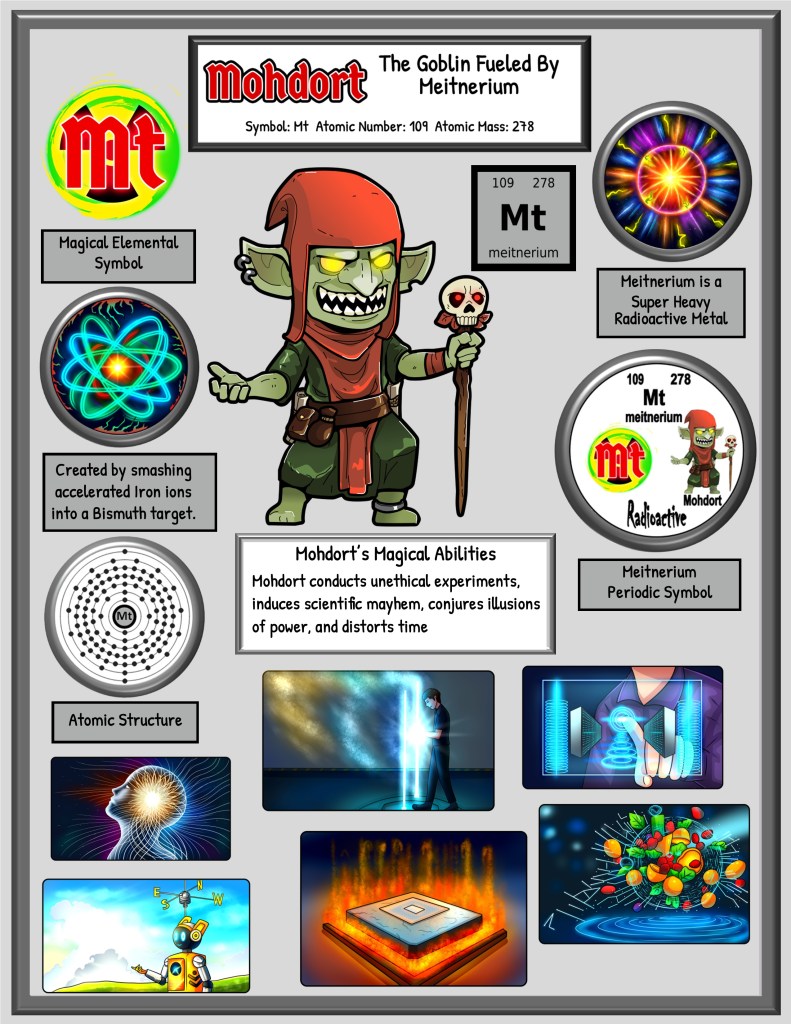
Currently, Meitnerium has no commercial applications. With a half-life measured in mere milliseconds—far too short to be practically useful—it’s primarily of interest in the realms of scientific research and the advanced study of atomic behaviors. Scientists continue to explore its properties to better understand heavy elements and nuclear reactions, a pursuit that is crucial for grasping the fundamental truths about matter and energy in our universe.
But what of the future? If we dare to look ahead, we can indulge in a bit of scientific speculation. While Meitnerium has not yet been tied to any specific technological application, its placement in the periodic table suggests a world of possibilities. Situated in Group 9 alongside other intriguing elements like Iron and Cobalt, its properties might one day reveal themselves in surprising ways.
Imagine harnessing the unique atomic structure of Meitnerium to create advanced materials with incredible strength or even super-heavy alloys that could revolutionize aerospace and automotive industries. In a more fantastical vein, one might even dream of using Meitnerium in the future of nuclear fusion technology, fueling rockets that traverse the stars. While these applications currently border on the realm of science fiction, the journey of scientific discovery teaches us that even the most improbable ideas can blossom into revolutionary truths.
As for its imaginative possibilities in science fiction, one can envision worlds where Meitnerium fuels the engines of interstellar ships, providing energy that transcends current technologies. Writers might imagine it as a component of mysterious devices that manipulate time and space, tapping into the fundamental forces that govern the cosmos. In the hands of a skilled author, Meitnerium could be the key to unlocking the mysteries of the universe, a catalyst for stories of exploration, adventure, and wonder.
The story of Meitnerium’s discovery is somewhat of a tale reminiscent of a grand quest. Lise Meitner, after whom the element is named, was a pioneering woman physicist who, despite facing challenges in her career due to WWII and subsequent exile from her homeland, contributed significantly to the discovery of nuclear fission. She and her collaborator Otto Hahn laid the groundwork for understanding nuclear reactions, a legacy that was ultimately overshadowed in recognition by Hahn, despite Meitner’s crucial role. Naming the element in her honor was an effort to correct this historic oversight and celebrate her contributions to science.
Some might find poetic irony in the fact that Meitnerium—representing the super-heavy neutron-rich isotopes—might also be seen as a torchbearer for change in a field where women were historically sidelined. Its existence is a symbol not just of scientific achievement but of resilience and the ongoing fight for recognition in male-dominated fields. The struggle and triumph of individuals like Lise Meitner add depth and meaning to the story of this elusive element; it reminds us that science is as much about people and their stories as it is about formulas and experiments.
While Meitnerium may evade our daily lives, its essence is woven into the fabric of our understanding of the atomic world. Its fleeting nature and scientific mystery enhance the beauty of our pursuit of knowledge. Whether it will one day find a commercial use or spark the imagination of writers and dreamers remains to be seen, but the legacy of Meitnerium is already rooted in the principles of exploration, discovery, and the boundless potential of human ingenuity. In that spirit, we are all invited to muse about what wonders await just beyond the horizon, waiting to be unleashed by the curious minds of tomorrow.
This article is brought to you by Sybrina Durant, the author of the Magical Elements of the Periodic Table Book Series. Learn More.

Inter-Active Elemental Fantasy-Themed Periodic Table from Magical Elements of the Periodic Table Presented Alphabetically by The Elemental Dragon Clan
Click here to use The Inter-Active Viewer for the periodic table above to learn more about the elements each elemental represents on this periodic table. Want this No Metal No Magic periodic table in a 24″ x 36″ Poster? Click here.

Sybrina Publishing Offers Fun Activities Based On The Book
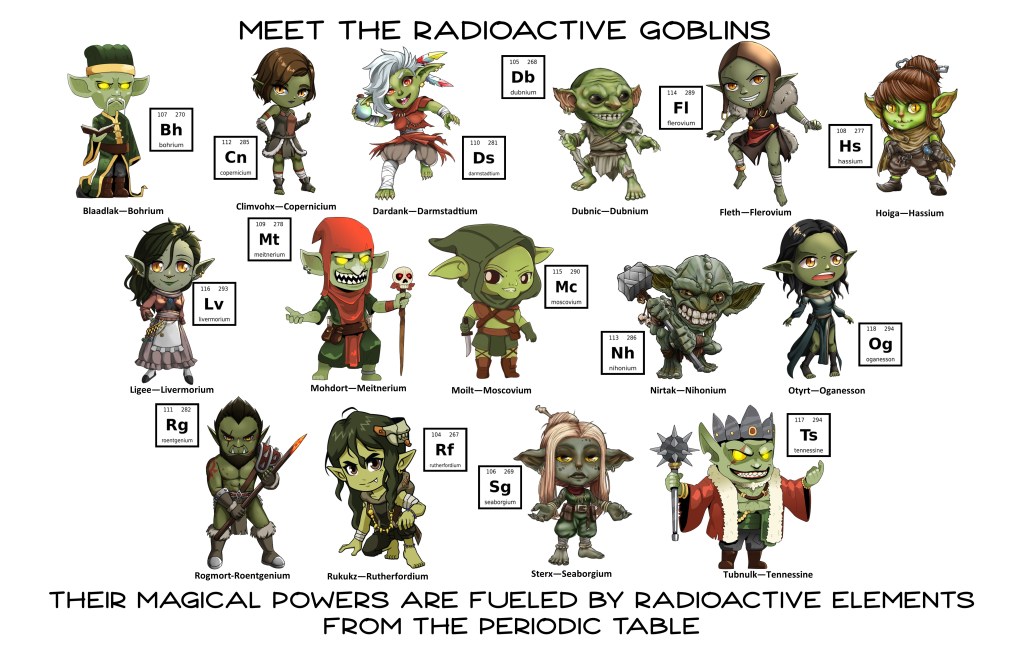
Magical Elements of the Periodic Table Magical Presented By The Radioactive Goblins
Browse Magical Elemental Activities at MagicalPTElements or Sybrina-Publishing on TPT or Classful