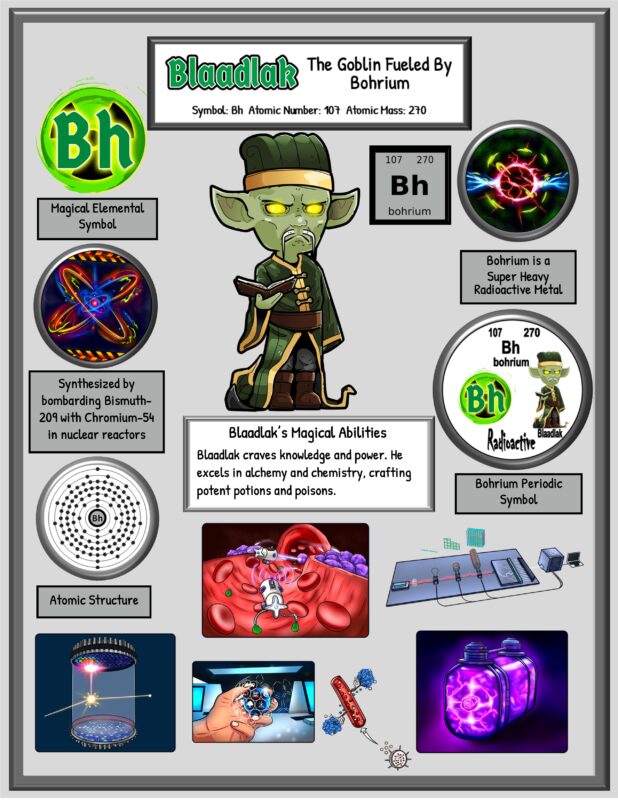

The periodic table serves as a map of all known elements that form everything around us—from the air we breathe to the bodies we inhabit. One of the lesser-known entries on this table is Roentgenium (Rg), an element so rare and mysterious that it seems almost otherworldly. Let’s embark on an adventure to discover Roentgenium, its secrets, potential future, and the story of its birth.
Roentgenium is a synthetic element, which means it was not discovered lurking in the Earth’s crust like gold or silver. Instead, scientists created it in a lab under carefully orchestrated conditions. Named after Wilhelm Conrad Röntgen, the physicist who discovered X-rays, Roentgenium occupies a spot in the periodic table as the 111th element and resides in the seventh period and group 11, alongside notable elements like gold and copper.

In 1994, the unassuming halls of the GSI Helmholtz Centre for Heavy Ion Research in Germany bore witness to an incredible feat. Scientists bombarded bismuth with ions of nickel, a high-stakes game that required immense precision and a bit of luck. After countless attempts, they succeeded in creating just a handful of atoms of Roentgenium! Imagine the exhilaration rippling through the lab—a discovery that would add an entire new character to the elemental world.
Roentgenium is not your run-of-the-mill element. Being placed in group 11, it is presumed to exhibit similar properties to gold, yet no one has had the chance to observe its characteristics in a way that could provide a detailed understanding. This is because Roentgenium is extremely unstable; while gold sits comfortably with a stable existence, Roentgenium lasts merely milliseconds before it decays into other elements. It is like trying to capture a fleeting shadow—there one moment, and gone the next.
Currently, Roentgenium is not used commercially, a fact that might seem disappointing. Picture this: scientists have created only a handful of atoms! There’s simply not enough of it to harness its properties for industrial use. But as dreams of artisans painting with rare pigments or inventors fabricating groundbreaking technology, hints of its potential loom tantalizingly in the future.

So why does Roentgenium command our attention? Scientists speculate that its future might hold possibilities that resonate through various innovative landscapes. Given its position, Roentgenium may possess unique properties akin to those of gold, yet with added exotic traits. Perhaps one day, it could be used in advanced electronics, serving as a premium component that operates at unprecedented speeds or within extreme conditions.
In a more imaginative context, let’s spin our wheels a bit. Imagine a future not too far away, in a world populated by interconnected nanobots carrying out intricate tasks—perhaps Roentgenium is at the heart of these micro marvels. Its potential radiation properties could pave the way for novel imaging techniques far beyond today’s technologies. Hospitals could benefit from new diagnostic methods for diseases, exploring the inside of a body with precision that was previously a figment of science fiction.
Every element has its legendary tales, and Roentgenium is no different. Despite its brief moment of existence, its discovery continues to unfold like a captivating novel. The very name, after the inventor of X-rays, sparks a connection to the way science unveils mysteries of the cosmos. Picture scientists in lab coats, resembling alchemists from an ancient era, peering through massive cloud chambers and cyclotrons, holding their breaths as they await the shining moment of atom formation.
Moreover, the element stands as a testament to human ingenuity. The sheer effort that goes into creating synthetic elements—experiments requiring vast resources, time, and global cooperation—illustrates a broader point. Humanity’s longing to uncover the mysteries of nature propels us forward. While Roentgenium is fleeting, its presence in the periodic table signifies the potential of the unknown and the pursuit of knowledge.
In a nutshell, Roentgenium epitomizes an intriguing blend of reality and fantasy. While it currently remains an exotic element confined to the sterile environment of laboratories, the whispers of its potential remind us that science fiction often creeps into the realm of possibility. Its mysterious nature sparks the imagination of scientific pioneers, leading many to dream about what could be when we unravel more of the secrets the universe holds.
As we walk through this gallery of elements, Roentgenium stands as a fleeting yet remarkable creation, a mere whisper in the symphony of the cosmos. Who knows? In some distant future, it may play a role we have yet to conceive—a thread in the fabric of tomorrow’s technologies and explorations. So, keep your eyes on the stars and within the realms of the extraordinary, as humanity continues to write the tale of discovery, with every element adding its chapter to our understanding of the wondrous world around us.
This article is brought to you by Sybrina Durant, the author of the Magical Elements of the Periodic Table Book Series. Learn More.

Inter-Active Elemental Fantasy-Themed Periodic Table from Magical Elements of the Periodic Table Presented Alphabetically by The Elemental Dragon Clan
Click here to use The Inter-Active Viewer for the periodic table above to learn more about the elements each elemental represents on this periodic table. Want this No Metal No Magic periodic table in a 24″ x 36″ Poster? Click here.

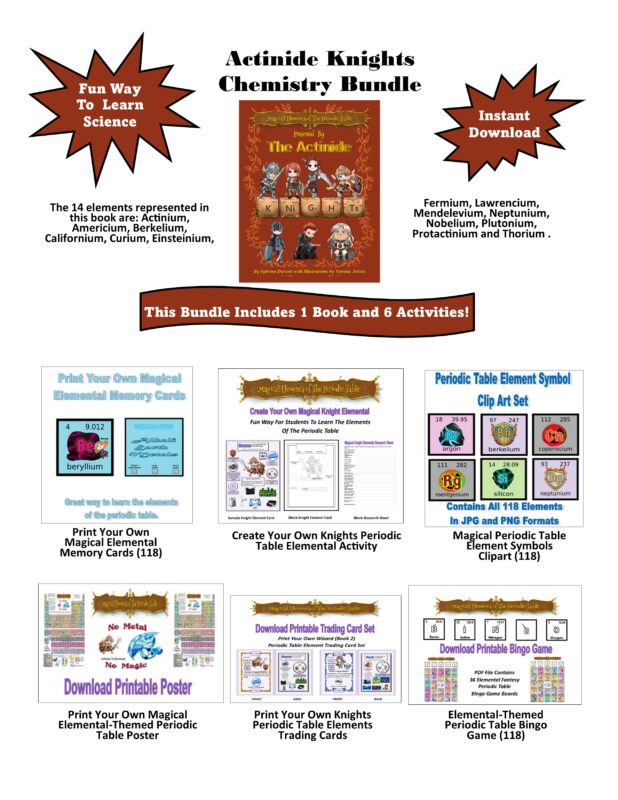
Sybrina Publishing Offers Fun Activities Based On The Book
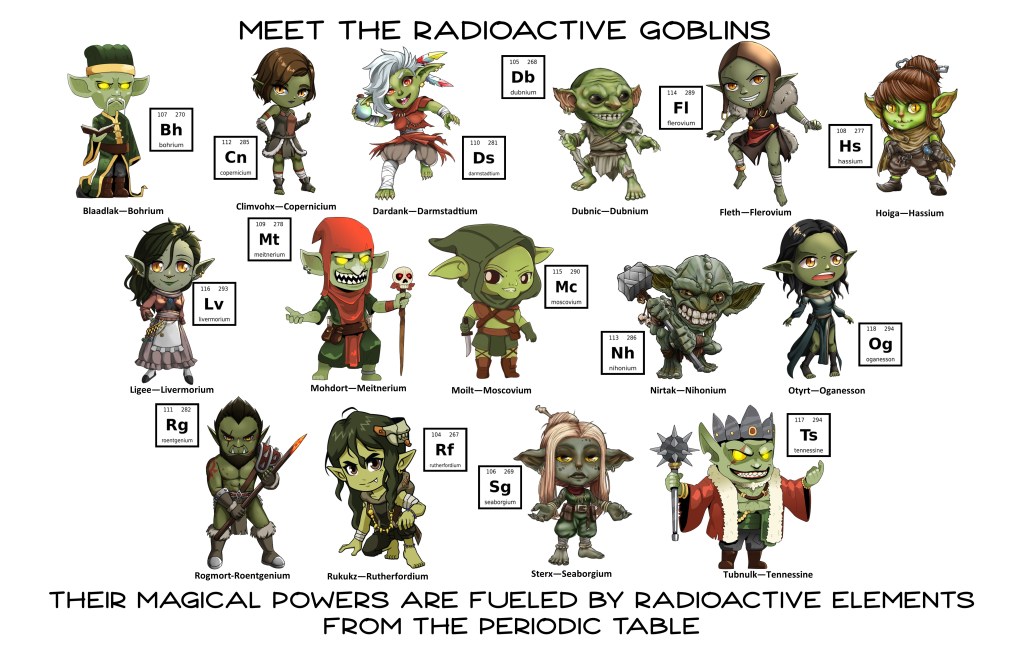
Magical Elements of the Periodic Table Magical Presented By The Radioactive Goblins
Browse Magical Elemental Activities at MagicalPTElements or Sybrina-Publishing on TPT or Classful