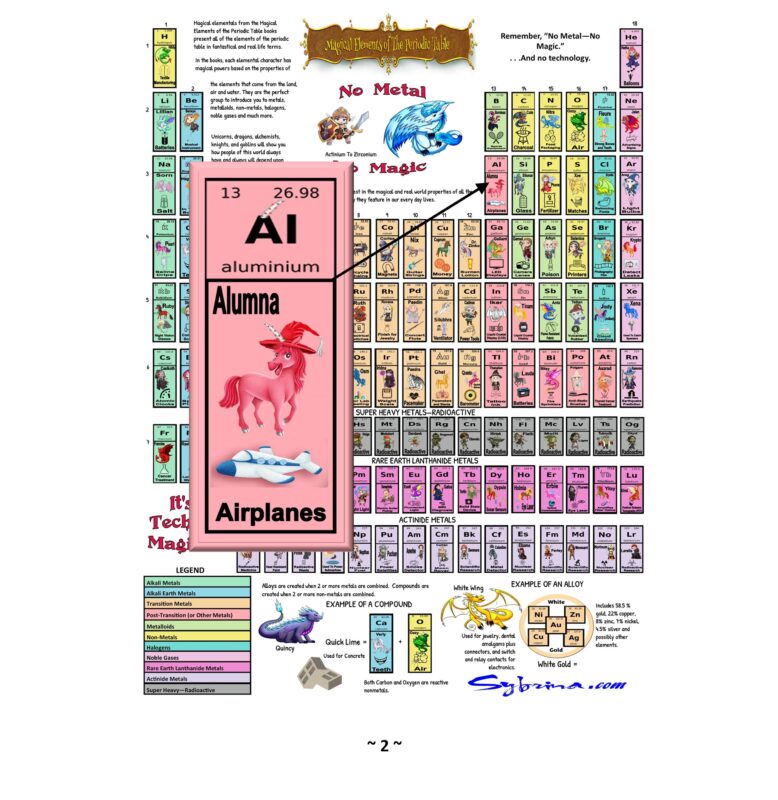

If you’ve ever wished you could step inside a fantasy world where science isn’t the enemy of wonder—where real chemistry concepts power real adventures—then you’re in for something special. Welcome to MarBryn, a breathtaking realm where civilization runs on elemental truth, and every spell, machine, and miracle begins with the one rule everyone learns early:
No Metal, No Magic.
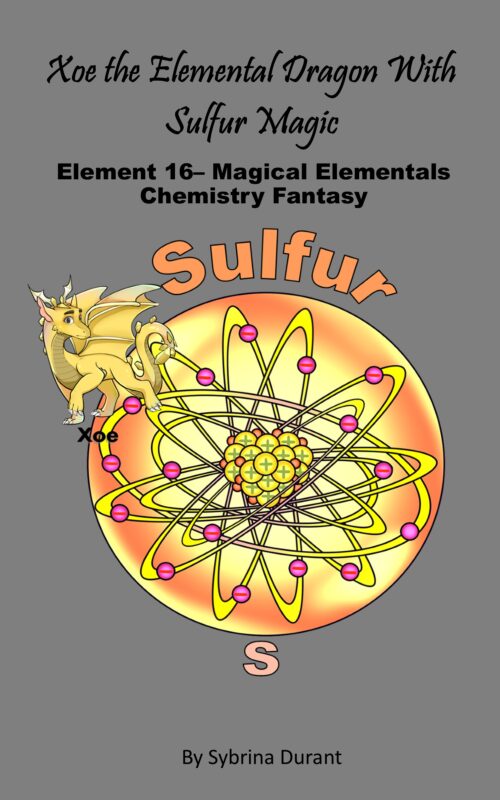
In Xoe The Elemental Dragon With Sulfur Magic: Element 16 — Magical Elementals Chemistry Fantasy Series, the hero isn’t a wizard with a staff. It’s a dragon—calm, analytical, compassionate—whose magical abilities are rooted in one of the most essential elements on the periodic table:
Sulfur (Element 16)
Because in MarBryn, the elements aren’t just background details—they’re the story itself.
Sulfur, Dragons, and Saving a Planet — Why Xoe Is the Fantasy Hero Your Young Reader Needs Right Now
Posted in: Book Reviews | STEM Education | Fantasy Adventure | Series Spotlight
What if the periodic table was not just a chart on a classroom wall but a living, breathing map of magical power? What if every element had a champion — a hero whose very existence was rooted in the chemistry that holds the universe together? That is exactly the inspired premise behind the **Magical Elementals Chemistry Fantasy Series**, and the sixteenth book in this spectacular collection is here, and it is absolutely not to be missed.
Xoe The Elemental Dragon With Sulfur Magic introduces us to one of the most compelling elemental heroes in the series so far — a breathtaking sulfur dragon named Xoe whose golden scales, amber crystal spine, and extraordinary elemental powers are rooted in the real science of Element 16 — Sulfur. She flies. She breathes fire. She heals the wounded and outsmarts her enemies with equal grace. And she does it all while carrying the quiet, disciplined wisdom of someone who understands that knowledge and power are only as good as the intentions behind them.
A Story That Does More Than Entertain
At its heart, Xoe The Elemental Dragon With Sulfur Magic is a story about what happens when brilliant minds lose their ethical compass — and what it takes to set things right. When a catastrophic Forced Elemental Siphon begins draining MarBryn’s most vital sulfur reserves and threatening the foundations of six cities, Xoe assembles an unlikely team of companions: a witty cartographer with no magic but boundless confidence, a sharp-minded alchemical engineer, a teenage metallurgy apprentice of extraordinary talent, and a quietly formidable ranger with a long memory and excellent aim.
Together they cross stunning fantasy landscapes — from the glittering Crystalline Marshes of Pellowfen to the ancient ruins of the First Alchemical Academy — battling mechanical sentinels, navigating volcanic lava tubes, and facing down an adversary whose genius is matched only by his capacity for catastrophic miscalculation.
Why This Series Belongs on Every Bookshelf
The Magical Elementals Chemistry Fantasy Series has always done something genuinely rare — it makes chemistry exciting without sacrificing the depth and wonder of great fantasy storytelling. Each book in the series is anchored to a specific element from the periodic table, weaving real chemical properties and historical uses of that element into the magic, the world-building, and the character design.
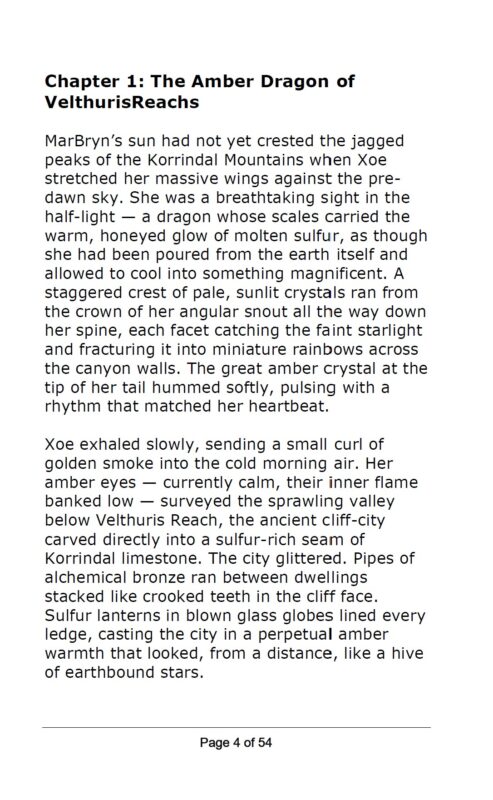
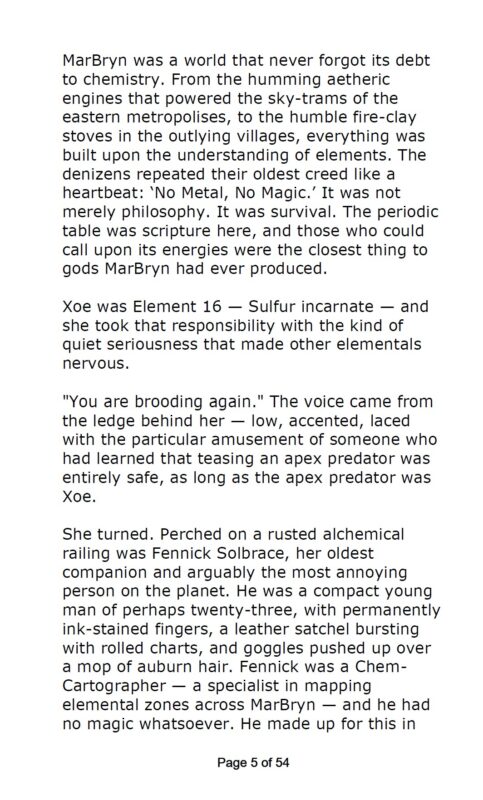
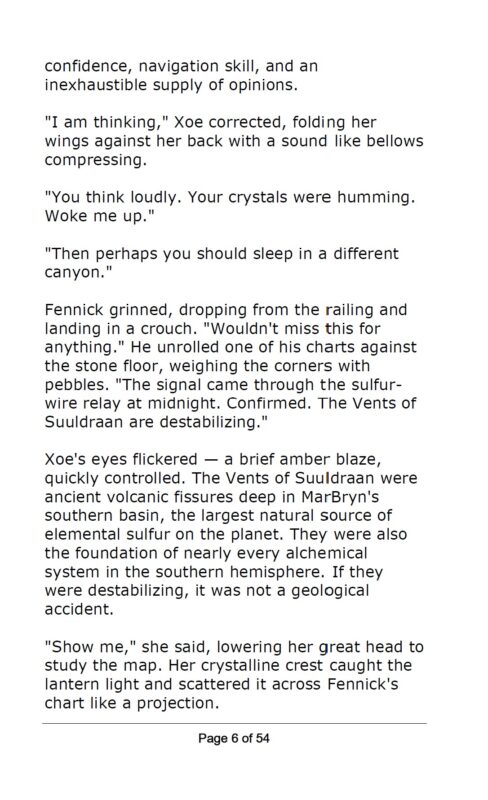
In Xoe’s case, that means sulfur — one of the oldest known elements in human history, essential to life, used medicinally for thousands of years, and the foundation of some of the most important industrial chemistry on Earth. Young readers finish this book knowing things about sulfur they never knew before, and more importantly, they finish it wanting to know more.
That is the magic trick this series pulls off, book after book — it disguises education as pure adventure, and it does it so well that you barely notice the learning happening until you are already hooked.
Perfect for a Wide Range of Readers
Whether your young reader is a devoted dragon enthusiast, a budding scientist, a fantasy adventure lover, or simply someone who enjoys a great story with memorable characters and genuine heart, Xoe The Elemental Dragon With Sulfur Magic delivers on every level. The action sequences are thrilling. The humor is perfectly timed. The emotional beats land with real weight. And the underlying message — that curiosity, integrity, and teamwork matter more than any individual power — is one that resonates long after the last page is turned.
Educators and parents take note: this series is an extraordinary tool for making STEM subjects engaging and accessible. The books work beautifully as independent reads, as classroom companions, or as springboards for deeper conversations about chemistry, ethics, scientific responsibility, and the nature of discovery.
Ready to Start the Adventure?
Xoe The Elemental Dragon With Sulfur Magic is available now. If you are new to the series, there has never been a better time to begin — and if you are already a devoted fan, you already know what to do.
Collect all sixteen books in the Magical Elementals Chemistry Fantasy Series and journey through the entire periodic table, one extraordinary elemental hero at a time.
No Metal, No Magic.
And no better time to start reading.
Pick up your copy of Xoe The Elemental Dragon With Sulfur Magic today and discover why the Magical Elementals Chemistry Fantasy Series is the fantasy adventure series that makes science unforgettable.
Get it in Kindle, Paperback or Audio.
Links and Notes for Xoe’s chemistry inspired magical abilities:
Sulfur basics (Xoe’s identity as Element 16, her amber/gold coloring, crystal formations)
Sulfur is element 16, naturally occurs as bright yellow crystals, and forms several crystalline allotropes — explains Xoe’s honeyed scales and the “staggered crest of pale, sunlit crystals” along her spine.
- Sulfur – Element information, properties and uses (Royal Society of Chemistry)
- Sulfur | Britannica
- Sulfur – Wikipedia (allotropes, crystal forms)
- Allotropes of sulfur – Wikipedia
- 2 Ways to Grow Sulfur Crystals – Science Notes
Molten sulfur and volcanic vents (the Vents of Suuldraan, sulfur lanterns, “poured from the earth”)
Sulfur really does erupt in molten form at some volcanoes and collects around fumaroles (volcanic gas vents)
- Fumarole – Wikipedia
- EarthWord: Fumarole – USGS
- Fumaroles – U.S. National Park Service
- Did You Know Volcanoes Can Erupt Molten Sulfur? – Discover Magazine
Burning sulfur / Xoe’s fire breath and toxic fog
Sulfur genuinely burns with a distinctive blue flame and produces sulfur dioxide gas, and hydrogen sulfide (also sulfur-associated) is a real toxic, foul-smelling gas that can incapacitate people at high concentration — the “toxic yellow fog” and “ignited fire wall” scenes.
- Brilliant Blue Sulfur Fire is Beautiful, Toxic Mess – Nerdist
- Hydrogen Sulfide – Overview | OSHA
- Hydrogen Sulfide | ToxFAQs – ATSDR/CDC
- Hydrogen sulfide – Wikipedia
Draining sulfur destabilizing the bedrock (Calx’s Siphon fracturing tectonic support columns)
Well-documented science for explainging extracting fluid/gas from underground at scale is a documented real-world cause of ground instability and induced earthquakes.
- Induced seismicity – Wikipedia
- How does the injection of fluid at depth cause earthquakes? – USGS
- The physical mechanisms of induced earthquakes – Nature Reviews Earth & Environment
- Does fracking cause earthquakes? – USGS
Nuclear transmutation (the core idea behind the “Omni-Element”) Real transmutation — changing one element into another — is genuine physics, just nuclear rather than chemical/alchemical. It happens by altering an atom’s proton count, not by “binding” elemental energies
- Nuclear transmutation – Wikipedia
- Transmutation | Nuclear Reactions, Radioactivity & Fission – Britannica
- Nuclear Transmutation – Chemistry LibreTexts
Radioactive decay and unstable nuclei (backing for “spontaneous decomposition releasing energy equivalent to a volcanic event”)
Real-world mechanism for Xoe’s line that a forced multi-element bond would be “extraordinarily powerful for a very short time, then undergo spontaneous decomposition.” Unstable atomic nuclei genuinely do release large amounts of energy as they break down toward a stable configuration — this was the legitimate physical basis for “the compound would tear itself apart violently.”
- Radioactive decay – Wikipedia
- DOE Explains…Radioactivity – U.S. Department of Energy
- Explainer: Radiation and radioactive decay – Science News Explores
- The Radioactive Atom: An Overview – CDC
Superheavy elements and the “island of stability” (the strongest single hook for the Omni-Element)
Scientists really do synthesize new superheavy elements in labs, and they really are extraordinarily unstable — most decay in fractions of a second. But there’s a real, actively-researched hypothesis called the “island of stability,” proposing that certain not-yet-created superheavy nuclei could be far more stable than their neighbors. That’s a near-perfect scientific mirror for Calx’s obsession: a brilliant researcher chasing a theoretical configuration of matter that mainstream science says is reckless to pursue at scale, but which isn’t crazy as a hypothesis.
- Superheavy element – Wikipedia
- Island of stability – Wikipedia
- DOE Explains…Superheavy Elements – U.S. Department of Energy
- A Route Toward the Island of Stability – APS Physics
Alchemy-to-nuclear-physics history (thematically useful for the “No Metal, No Magic” creed and Calx’s Academy backstory)
Real history actual lyshows that alchemists spent centuries trying to transmute lead into gold and failed, and it wasn’t until 20th-century nuclear physics that transmutation became genuinely achievable — just not by the means alchemists imagined. That arc (ancient obsession → modern vindication via an entirely different mechanism) is basically Calx’s character arc.
- What Is Transmutation? From Alchemy to Nuclear Science – ScienceInsights
- Alchemy by pure light – CERN Courier
- The Roots of Chemistry: How Alchemy Influenced Modern Scientific Thought – UC Davis Aggie Transcript
Author’s Fantasy License:
Sulfur doesn’t actually have healing properties as depicted with Xoe’s touch, and elements can’t be permanently “bonded across categories” the way the Omni-Element concept implies — real elemental fusion (turning one element into another) requires nuclear reactions, not alchemy-style binding.